
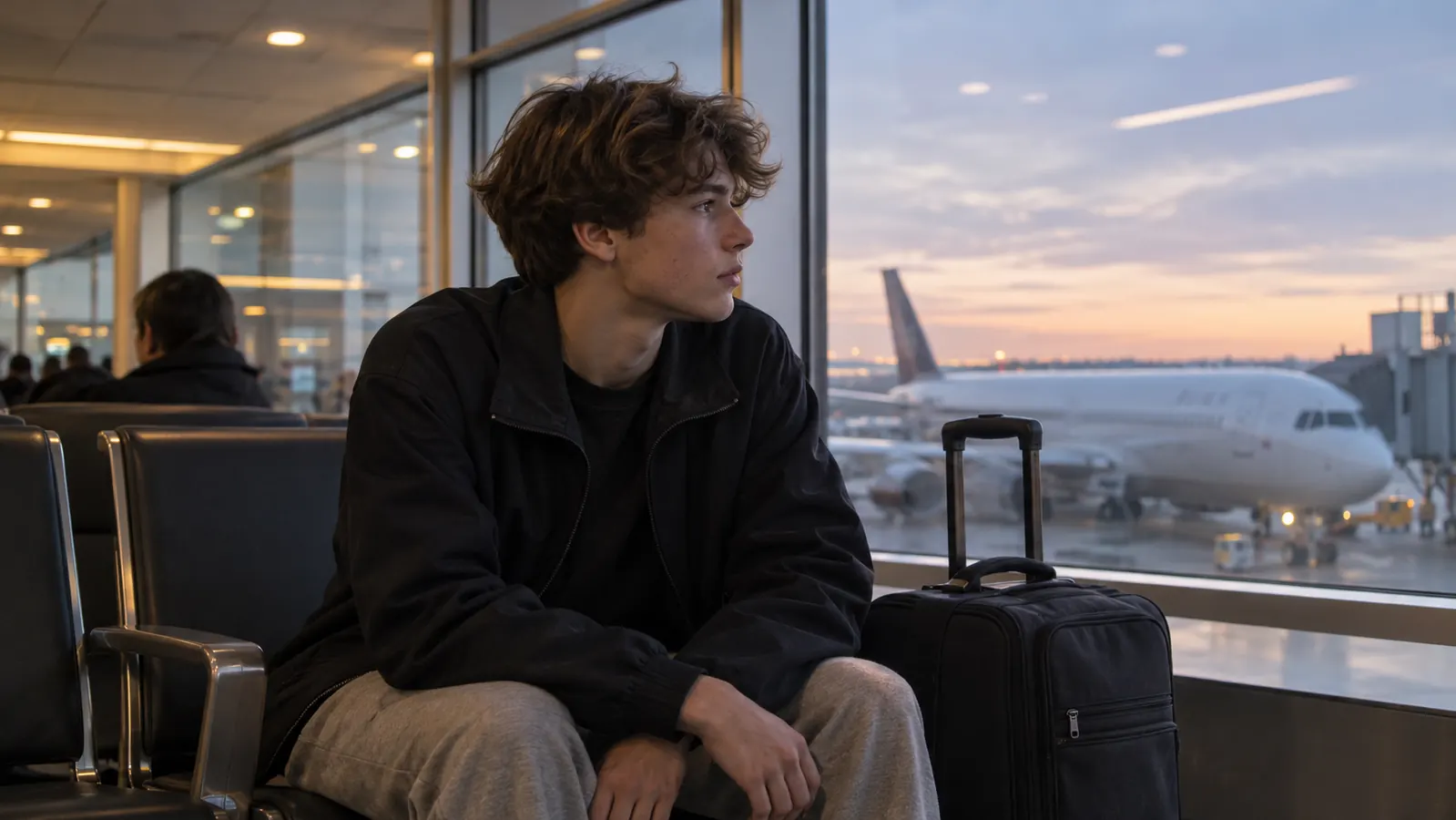
I have flown to a road game exactly twice a season for the last several years, and I have made just about every mistake a person can make on the way to the airport. I have packed a pillow that would not bend. I have tried to sleep sitting straight up in a middle seat with my chin on my chest and woke up with a stiff neck that lasted three days. Renee still brings that up at dinner.
What finally worked was not a trick. It was a short routine, done the night before, plus one piece of gear that does what it says. For us that gear is the Dot&Dot Twist pillow, a 26 inch memory foam roll with a bendable rod inside. Renee uses it in the passenger seat of the Tahoe on the drives. On a plane it is mine, because she usually leaves it in the car. Here is the routine, step by step, in the order I actually do it.
The pillow that survives being folded into a carry-on and shaken back out at the gate
Memory foam, a washable cotton cover, and a bendable rod so you can shape it around your neck instead of propping your head against a tray table.
Amazon Check Today's Price on Amazon →Step 1: Book the seat you can actually sleep in, not the seat that looks good
This is the step people skip, and it decides everything after it. A window seat gives you a wall to lean against. An aisle seat gives you room to stretch but nothing to rest your head on, and you will spend the flight bobbing. I take the window on any flight over two hours. I will take the aisle on anything shorter than that, because on a short hop I am not sleeping anyway.
I learned that on a flight two seasons back. I booked a late afternoon departure and took the aisle because it was all that was left, telling myself I would stretch out. Instead I spent three hours with my shoulder against the seat back and my head rolling forward every time I dozed off. By the time we landed my neck was stiff and I was short with the woman at the rental counter. Renee had the window that day and slept most of the way. I have not given up the window since.
There is a second part to this. Think about the direction you are flying and when. A morning flight east puts the sun on the left side of the plane. A late flight west puts it on the right. If you are the kind of person who cannot sleep with light on your face, pick the side away from the sun, or pack something to cover your eyes. I keep a folded bandana in my jacket pocket. It cost me nothing and it works.
And do not count on the seat being comfortable. It is not. The cushion is thin, the recline is short, and the seat back is a board. Every step after this one is about making up for that.
Step 2: Bend the pillow into shape before you sit down, not after
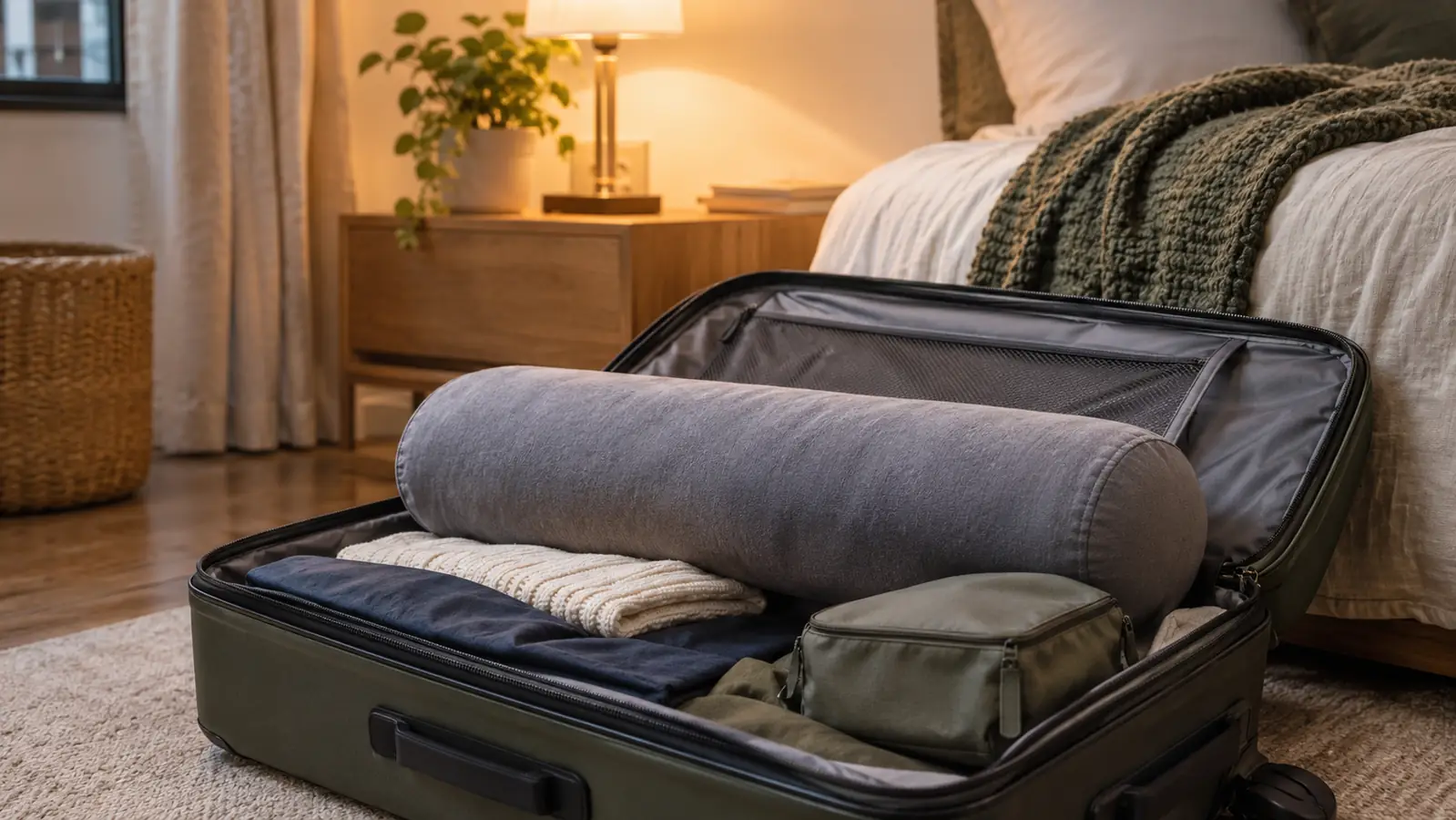
This is where the Dot&Dot Twist earns its place. It has a rod through the middle, so it holds whatever shape you bend it into. The pillow itself is about 3.8 inches across and 26 inches long, and the rod inside is about a centimeter in diameter. That sounds like a small thing until you try to sleep with a pillow that will not stay put.
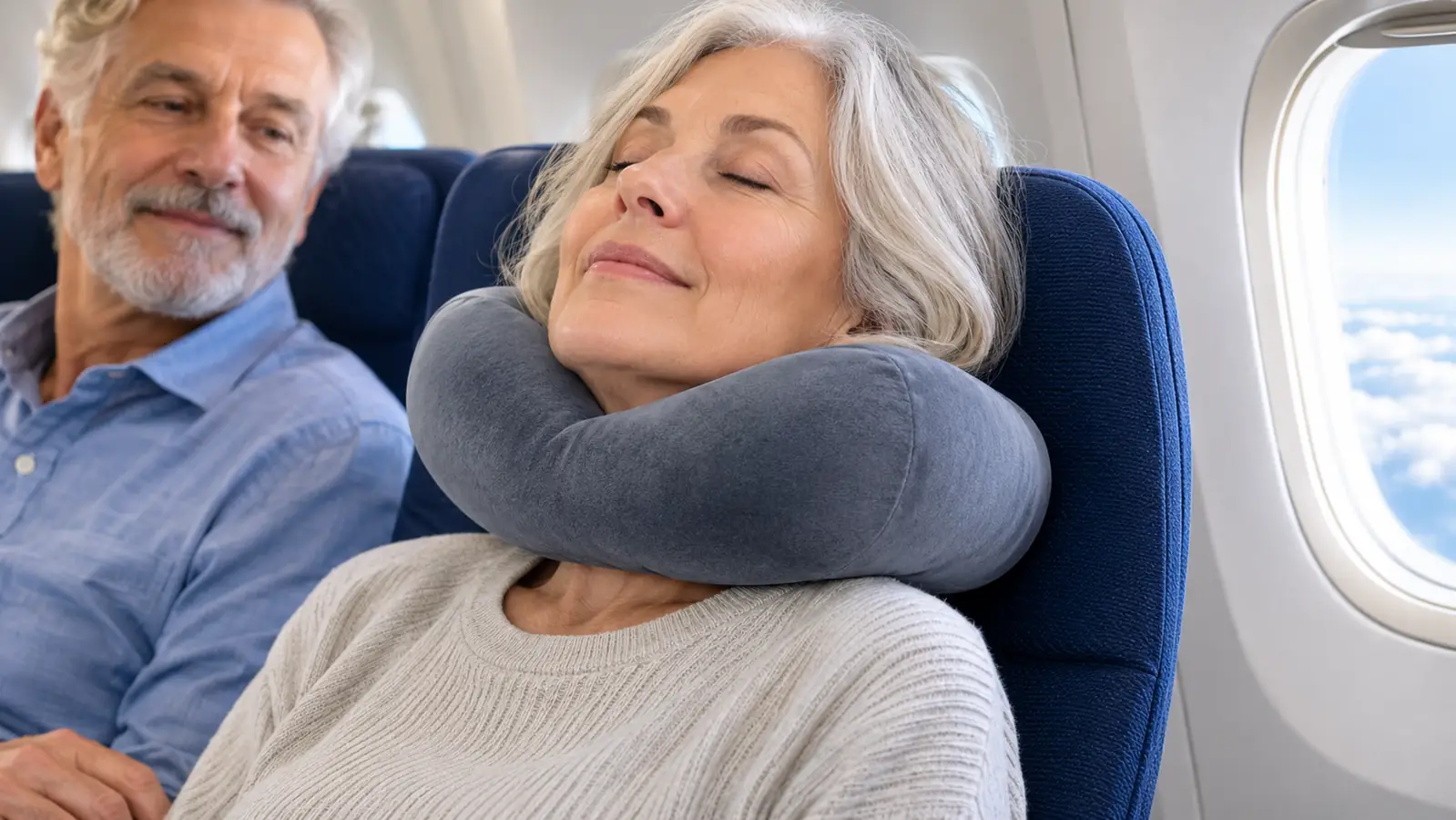
Here is what I do in the gate area, before boarding. I bend the middle of the pillow into a U for the back of my neck, then bring the two ends forward and up so they sit under my jaw on both sides. Then I test it. I lean my head back like I am going to sleep and see if my chin drops. If it does, I bend the ends up a little more. That takes about thirty seconds and it means I am not fighting the thing in a cramped seat with the tray table down.
The first time I used it, I bent it into a plain horseshoe and left it at that. It slid down my neck inside of twenty minutes and I woke up with my chin on my chest, which is the exact thing I was trying to avoid. The fix was bringing the ends up higher, under the jaw, instead of letting them rest on my collarbone. One change, and the pillow went from being in the way to being useful. Now I check the shape in the gate chair every single time, and I have not had the chin drop since.
One honest note. The rod takes some bending. You are not going to nail the shape on the first try, and it will feel too firm at first. Give it a couple of minutes and keep adjusting. It is memory foam, so it does soften up against your neck after a bit.
Step 3: Dress for the cabin, not for the weather at home
Cabin air is dry and the temperature swings. I have been on flights where I was cold for four hours and flights where I was sweating before we pushed back. Both ruin sleep. The fix is a layer you can take off, a light jacket or a long sleeve over a t-shirt, and pants with a little give in them.
Two small things that matter more than people think. First, your shoes. Loosen them or take them off once you are at altitude. Feet swell, and tight shoes will keep you awake longer than any noise on the plane. Second, empty your pockets before you sit. Keys and a phone in a front pocket will dig into you the whole flight.
I also wear the pillow around my neck from the gate, not in my lap. It is bulky, it does not compress, and it does not fit in a small bag. Wearing it through the jet bridge means I am not digging for it in an overhead bin while everyone behind me waits.
Step 4: Set up the seat before you try to close your eyes
Do the chores first. Window shade down if you are on the sunny side. Tray table up and latched. Seat back reclined as far as it goes, which is not far. Headphones on, even if you are not playing anything, because they cut the cabin noise and they signal to the person next to you that you are done talking.
Then get the pillow seated correctly. The back of it should sit at the base of your skull, not up on the crown of your head. The two ends come forward under your jaw. If you are in a window seat, you can also twist the pillow into an L, hook one end against the window, and let the other end support your jaw. That shape is the reason I like this pillow over a fixed horseshoe. It bends to the seat you are in.
That L shape earned its keep on a flight last season. The man in front of me reclined his seat the whole way, which took about four inches out of my space. I hooked one end of the roll against the window frame and ran the rest of it down along my jaw, and it held there for the better part of two hours. A horseshoe pillow would have been on the floor by the second hour. It was not a comfortable flight, but I slept, and that was the whole point of carrying the thing.
The last thing is your phone. Put it away. I know how that sounds. But scrolling in a dark cabin is the fastest way to stay awake for the whole flight. If the game is on and you are following it, fine, but understand that you are choosing the score over the nap.
The trick is not the pillow. It is bending it into shape at the gate, while you still have elbow room, instead of fighting it in a middle seat with the drink cart coming.
Step 5: Give yourself a real window, and know when to stop trying
Most flights to a road game are two to four hours. You are not going to get a full night of sleep and you should stop expecting one. What you can get is one solid stretch of an hour or ninety minutes, and that is worth a lot when you land, get a rideshare to the hotel, and turn around and go to the stadium.
So set a soft rule. Give yourself twenty minutes to fall asleep. If you are still awake at that point, stop grinding at it. Sit up, drink some water, look out the window. Trying hard to sleep is the surest way not to. Then try again later in the flight. I have had good naps on the second half of a flight after failing completely on the first.
And know your own limit. If you are the one driving to the airport, or the one driving from the airport, you are not sleeping on that leg. Renee sleeps on the plane and I do not, on the flights where we both go. On the flights where she stays home, the pillow is mine and I take the nap. Nobody in my house sleeps behind the wheel, and that includes a short hop from the rental counter to the hotel.
What Else Helps
The pillow does the heavy lifting for your neck, but it will not fix a bad setup. A few other things carry their weight. An eye mask is the cheapest improvement you can make, because cabin light comes from everywhere. Earplugs or a pair of foam earbuds do more for sleep than any music will. A bottle of water bought after security keeps you from waking up with a dry throat, and cabin air will do that to you.
There is also the matter of when you eat. I stopped buying the airport meal right before boarding. A heavy meal and a short flight do not mix, and I would rather be a little hungry and sleepy than full and wide awake. I eat at the gate now, something plain, and I drink water instead of a soft drink. That is not a rule I read anywhere. It is just what I noticed after enough flights where I could not settle down no matter what I did.
The other thing I carry is the clear bag. It is a 12 by 6 by 12 inch tote, 13.5 liters, and it holds both phones, the wallet, and the power bank. On a plane it folds down into the carry-on. At the stadium it is what we carry to the gate. Many pro stadiums publish that size as the one they allow, but not all of them, and the rule changes, so check the stadium's own website before you leave home. Never assume.
The power bank rides in the carry-on and never in checked luggage, and I would say the same to anybody. Check the airline's rules on it before you fly, because those vary too. Mine is a 20,000 mAh unit and I top off both phones the night before a trip. It is heavier than it looks, so it goes in the bag, not a pocket.
The cooler and the stadium seats stay home on a plane trip. There is no version of that flight where a 50 can cooler bag makes sense. The seats only travel when we are driving and only when that stadium's site allows a seat with a back, which many of them do not.
If you want the longer version of how the pillow has held up over a couple of seasons, I wrote that up separately, and there is also a straight comparison against the inflatable I used to carry. Short version of the comparison: the inflatable went soft on me mid flight and I quit carrying it. The Dot&Dot has not done that, because there is nothing to inflate.
Bend it at the gate, sleep on the plane, and stop waking up with your chin on your chest
26 inches of memory foam with a bendable rod, a cotton cover that goes in the wash, and 16 ounces of weight that fits around your neck instead of in your lap.
Amazon Check Today's Price on Amazon →