
Fifteen months ago I stood in a stadium parking lot about forty minutes before kickoff and watched my phone go black. Both digital tickets were on it. Renee's phone still had enough battery, she got the tickets moved over, and we walked in a little late. We missed the anthem and nothing else. That is the short version of why an INIU power bank has lived in the center console of my Tahoe ever since. I bought this one the week after that afternoon, and it has been on every road trip and both flights since.
I am 61, retired four years from a parts manager job at a truck dealership in Baton Rouge, and I drive to six to eight pro road games a season with my wife. About two a season are by plane. I am not a gadget person. I want a charger that works when the tickets are on the phone, the map is running, and Renee is taking pictures of the field. The INIU has done that for fourteen months without much fuss. It is not perfect, and I will get to that, but it has earned its spot in the bag.
The Quick Verdict
A 20,000mAh power bank with a built-in cable, three ports and a display that tells you the truth. It is heavier than it looks and slow to refill, but it has kept two phones alive through some long days.
Amazon Check Today's Price →The Charger That Kept the Tickets Alive
This is the model I bought after my phone died in the parking lot. It goes in the clear bag at the gate, it rides in the console on the drive, and it gets recharged the night before every trip.
Amazon Check Today's Price on Amazon →How I've Used It
I bought the INIU fourteen months ago, the week after the dead phone. Before that I used a battery phone case for about eight months on an older phone. When I got a new phone, the case did not fit, and I never replaced it. That is why I was not carrying a charger that afternoon. I never used the case and the INIU together.
The power bank has been to somewhere around a dozen games since, plus two flights. On a road trip it stays in the center console until we park. Then it goes into the clear bag with both phones, the wallet, keys, tissues and a rain poncho. Renee carries the bag. At the gate I have had no trouble with it. I still check the stadium's website before every trip, because rules change, and I check the airline's rules before a flight. INIU says the capacity is TSA approved, and I keep it in the carry-on, never in checked luggage.
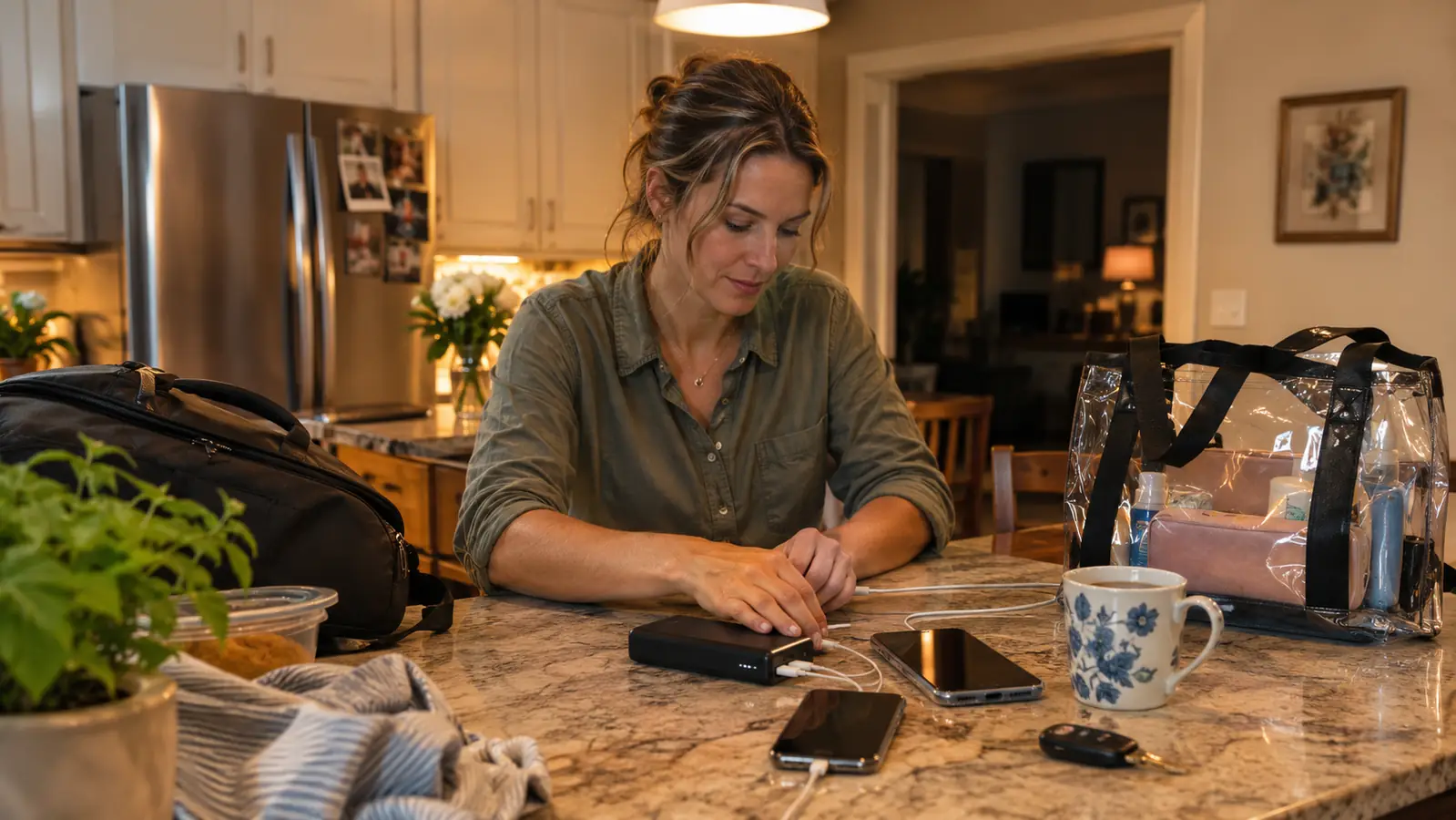
My routine is simple. The night before a trip I plug the power bank in on the kitchen counter next to the coffee maker, usually around eight. The listing says a full recharge takes about 5.4 hours, and that matches what I see, most of an evening. On game day I top off each phone once, sometimes twice if we are out late. One Saturday last fall I did it twice: once in the parking lot mid-morning before we walked in, and again on the tailgate afterward while Renee called her sister. The power bank was down to about a third when we got home. I have never run it all the way down on a single game day. The first month I owned it I carried it to the grocery store and back. That wore off once I trusted it to hold a charge.

What the Numbers on the Listing Actually Mean
The headline number is 20,000mAh. That is capacity, not a promise of a set number of charges, because phones differ. In practice it is enough for my phone and Renee's phone through a long day of maps, texts, photos and ticket checks, with power left over. That is the job. I am not trying to charge a laptop or run a campsite. I want two phones to make it from the house to the final whistle and back to the truck.
The 22.5W rating is the charging speed. INIU claims about 25 minutes to get a newer Samsung to 70 percent or an iPhone 16 to 60 percent. I have not timed it with a stopwatch, but it is quick enough to matter when we are walking from the parking lot and Renee realizes her phone is lower than she thought. The first time I used it I expected the phone to jump. It does not. It creeps, a few percent at a time, and then you look again and it is at 60. It is not a wall charger. It is a top-up that buys you hours.
There are three ports and a built-in cable. The built-in cable means I am not digging through the bag for my own cord. The extra ports mean Renee can plug in at the same time. The digital display shows a percentage, not four little dots, so I know whether I have a full game day or a partial one. The flashlight is a small extra. I used it once to look under the seat for a dropped ticket, and it did the job.
The outer shell is woven nylon, and INIU says it outlasts standard plastic by three times. I cannot test that claim, but I can say this one has ridden in a console and a clear bag for fourteen months and does not look worse for it. The listing also mentions thermal sensors. It gets warm when both phones are charging, the way any charger does, and I have not had a problem.
A Game Day From the Parking Lot to the Final Whistle
We usually park two or three hours before kickoff. I back into a spot near a light pole when I can, because leaving a night game is easier that way, and I drop a pin on my phone so I can find the truck in the dark. The cooler stays in the back of the Tahoe, behind the second row. The pillow stays on the passenger seat with Renee. The clear bag and the stadium seats ride on the second row. The power bank is in the center console until we park. Then it goes in the clear bag. That is the whole system, and it has not changed in fourteen months.
At the gate, the bag goes through the usual look. The power bank is in the main compartment. I have not had it questioned. I know that can vary by stadium and by the person at the gate, so I check the stadium's own website before we leave home. I do not promise anything gets through every gate. I just know what has worked for us.
During the game, Renee takes photos and sends them to family. Her phone is the older of the two and drains faster when she is on it, so hers is usually the one that gets the second top-off. I check the map after the game to get us out of the lot, and I keep my screen dim because I am stingy about battery. Neither of us worries about it anymore. That sounds small until you have stood in a parking lot with a dead phone and two tickets you cannot show. The INIU did not make the day more fun. It made the day less stupid, and that is what I want from a charger.
After the game it comes home in the bag, gets plugged in on the counter, and is ready by the next morning. If we are on a road trip and staying overnight, I plug it in at the hotel. If we are driving home late, I plug it in when we get there. It is not a thing I think about much, which is the point.
What It Is Like to Carry
It is heavier than it looks. The listing calls it pocket size, and I would say that means a jacket pocket, not a jeans pocket. In warm weather I do not have a jacket, so it rides in the clear bag. It sits in the side pocket of the bag so it does not land on top of the phones, and in the Tahoe it stays in the console tray and does not slide around on turns. It takes up room. If you want something you forget about in your front pocket, this is not that.
The built-in cable is the feature I use most. My phone plugs in without a separate cord. Renee still carries her own cable for her phone, because she has a different connector, and that is fine. The three ports mean we can both charge at once. The display is the other feature I trust. At a glance I know if I am at 80 percent or 20 percent. Four little dots would not tell me that.
The nylon outer has held up. It has been dropped into a console, zipped into a clear bag, and set on a tailgate. It has a few scuffs and that is all. The corners are the only place it shows wear, and even there it is a dull rub rather than a crack. The power bank is not the prettiest thing in the bag, but it is the one I would replace first if it quit.

Where It Falls Short
The weight is the main tradeoff. A 20,000mAh battery is not light, and this one feels solid in the hand. If you are walking a long way from the lot, you will notice it in the bag, more at the end of the night than at the start. I do not notice it on my shoulder, but I notice it when I pick up the bag. If you want a charger that disappears, get a smaller one and accept fewer charges.
A full recharge takes most of an evening. The listing says 5.4 hours, and that is about right. If you plug it in at bedtime and leave before morning, you may not be full. I recharge the night before, and I have a routine. If you are the kind of person who grabs things on the way out the door, this will bite you. A dead power bank is no better than a dead phone.
The built-in cable also means the phone and the charger have to sit together while charging. That is fine in the clear bag. It is less fine if you want to walk around with the phone in your hand. I have gotten used to setting both on the tailgate or in the cup holder and leaving them alone for a bit. Renee does not love it, because she likes her phone in her hand when she is talking to her sister. She has learned to plug in during the walk in and unplug at the gate.
It does not come with a wall block. The box has the power bank, a manual and the built-in cables. I use a block we already had in the kitchen. On a two-night trip last season I forgot it and had to stretch the recharge across two mornings, plugging in whenever we were in the room. That worked, but it was the one time in fourteen months I had to think about it. If you do not own a spare block, buy one and keep it in the bag with the charger.
What I Liked
- 20,000mAh keeps two phones alive through a long game day
- Built-in cable means one less thing to pack
- Three ports let both phones charge at once
- Digital display shows a real percentage
- Woven nylon outer has held up in a console and a clear bag
- TSA-approved capacity for carry-on use
Where It Falls Short
- Heavier than it looks and not a small-pocket charger
- Full recharge takes about 5.4 hours
- Built-in cable tethers the phone to the bag while charging
- Does not include a wall adapter
The display is the part I trust. Four little dots tell you nothing at 4:30 in the afternoon. A number tells you whether you have a long night or a short one.
Who This Is For
INIU is for the person who carries the tickets, the map and the camera on one phone. If you are the one in your group who always has the lowest battery, or if you are driving to a game with your wife and both phones are doing different jobs, this is a sensible thing to keep in the console. It is also for the traveler who wants one charger for two phones and does not want to carry a tangle of cables. The built-in cable and the display make it easy to use in a parking lot or a hotel room. It fits the clear bag we carry, and it fits the airline rules when it is in the carry-on.
Who Should Skip It
Skip it if you plug your phone in at night and never touch it on game day. A smaller charger will do. Skip it if you want something that vanishes in a jeans pocket, because this is not that. Skip it if you are not willing to recharge it the night before, because 5.4 hours is not a quick top-up. And skip it if you are looking for a charger to run a tablet or a laptop all day. This is a phone charger, and it is good at that job.
The One I Would Put in the Console
If your tickets, map and photos all live on one phone, this is the spare battery I would trust. Recharge it the night before, put it in the clear bag, and stop thinking about it.
Amazon Check Today's Price on Amazon →