
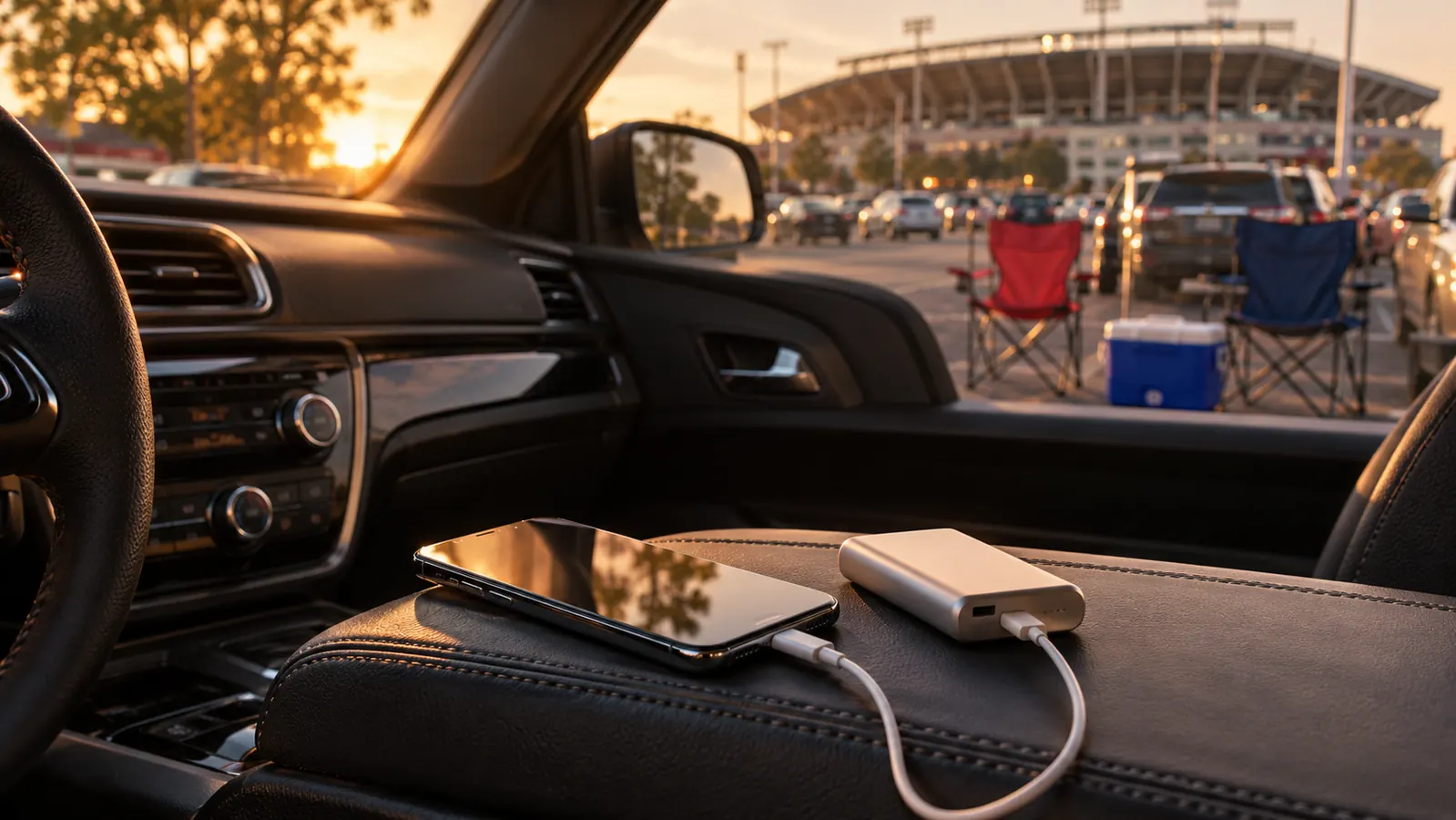
Fifteen months ago my phone went dead in a stadium parking lot about forty minutes before kickoff. Both digital tickets were on it. Renee's phone still had enough left in it, she took the transfer, and we walked in during the anthem. That is the whole reason there is an INIU power bank in the center console of my Tahoe today.
So here is the short answer on INIU versus a battery case. They solve the same problem from opposite ends. One is a brick you have to remember to pack. The other is a case you never have to remember, right up until the day you buy a new phone. I have owned both. I ran a battery case for about eight months on a phone I had before this one, and I quit using it when the next phone did not fit it. I have carried this 20,000 mAh INIU for fourteen months now, across six to eight road games a season and a couple of flights. Renee and I bought everything ourselves, so nothing here came out of a box with a note from a company attached.
| INIU Power Bank | A Battery Case | |
|---|---|---|
| What it charges | Any phone, tablet or earbuds case you plug in. Three ports and built in cables | The one phone it was molded for, and nothing else |
| Carrying it | A separate brick in the bag, denser and heavier than it looks | It is the phone case. Nothing extra to pack or remember |
| Capacity | 20,000 mAh. I top off two phones on a game day and still finish with charge left | Sized to get one phone through an afternoon, not a whole trip |
| Charging speed | 22.5W fast charging through the USB C ports | Slower. It trickles into the phone through the case |
| Recharging it | About 5.4 hours on the wall charger, which is most of an evening at home | Charges on the nightstand with the phone, nothing extra to think about |
| When you change phones | Still works. Plug in whatever you carry next | New phone means a new case, and the old one is finished |
| Airport and gate | Rides in the carry-on, never in checked luggage, and I read the airline rules first | It travels as your phone, so nobody asks about it |
| Best for | Long days, two phones, cold weather | Someone who wants zero extra objects in the bag |
The Day a Battery Case Was Not There
People ask me why I do not just use a battery case and be done with it. I did. I used one for about eight months on the phone I had before this one. It did what it said it would do. My phone was always a little thicker and always a little warmer, and I never once had to think about a charger.
Then I traded phones. The case did not fit the new one, and I did not buy another, because by then I had decided the phone I carried would hold a charge through a game day on its own. On the day my phone died in the parking lot, I was carrying nothing. No case, no brick, no cable. Both tickets were on a phone with a dark screen, and I was standing next to a truck with a cooler in the back and nothing to plug into.
Before the case I am talking about, I tried the free version. I kept a short cable in the console and told myself I would plug the phone into the truck's own USB port on the drive in. It worked about as well as you would guess. That port charges slow enough that the phone gained a few percent over forty minutes with the screen on running the map. It was fine on the way to the stadium and useless the moment we parked and walked away from the truck.
The part that stuck with me is not the dead battery. It is that the tickets lived on that battery. Once we were inside it turned into a fine afternoon. Before we were inside, it was a small problem that could have turned into a much bigger one. That is why I ordered the INIU the following week, and why it goes into the clear bag at the parking lot now instead of staying in the console.
I am not telling you a battery case is a bad idea. I am telling you what made me switch, and it was not a spec sheet. It was forty minutes in a parking lot with a phone I could not open.
Where the INIU Wins
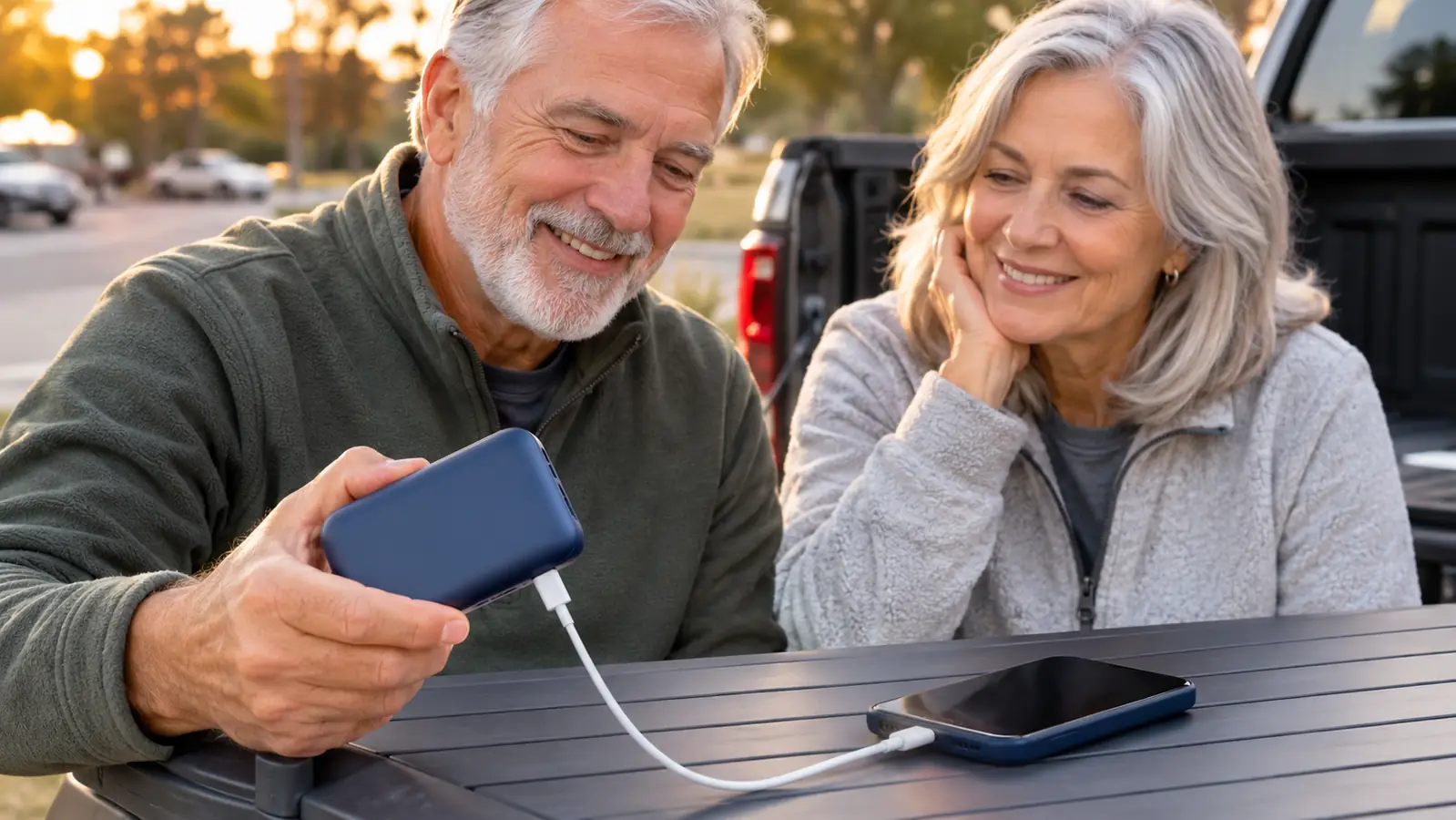
Capacity is the first thing, and it is not close. Twenty thousand milliamp hours means I can top off my phone, top off Renee's, and still have charge left over after the game when we are sitting in traffic trying to find the interstate. On a normal game day I top each phone off once. On a cold day, when both phones drain faster than they should because the cameras are working harder than usual, sometimes twice.
In practical terms, twenty thousand milliamp hours is about four full charges for a phone like mine, so a two phone game day uses a fraction of what is in there. That surplus is the point. I am not charging to a hundred percent and hoping. I top each phone off, put the brick back in the bag, and the display still reads a comfortable number when I check it in the parking lot afterward.
The second thing is that it does not care what you plug into it. Three ports, and built in cables, so I am not the guy walking the row of cars asking whether anybody has a cord. My phone, Renee's phone, my grandson's tablet on the drive home from a Saturday game. It has a digital display that shows the exact percentage left, which sounds like a small feature until you have guessed wrong on a two hour drive and watched a phone die at eleven percent.
Third is the charging speed. 22.5W through the USB C ports gets a phone back to useful in about the time it takes to walk from the truck to the gate, not the time it takes to sit through a half. The other thing I noticed early is that it does not get hot in my hand the way I expected a battery this size to get. There are thermal sensors inside that manage the heat. I cannot tell you how they work. I can tell you the brick ends up warm and not hot, which is what I care about in August.
There is also a flashlight built into the end of it. I have used it twice, both times looking for something that rolled under the seat after dark, and both times it beat the phone light because the phone was the thing I had plugged in.
Where a Battery Case Wins
I will give the case the honest part. It is one object. It is the phone in your hand, charged, with no cable to forget and nothing to remember at the door. There is real value in that, and I do not want to wave it away. I am the type who checks the console twice before a trip and even I have walked out to the Tahoe, started it, and then gone back inside for the power bank sitting on the kitchen counter.
A case also asks nothing of you at the airport. The power bank goes in the carry-on on our two flights a season and never in checked luggage, and I read the airline's rules before every trip because those rules can change between one season and the next. The capacity on this one sits inside the carry-on limit and it has gone through security without a question both times, but I still read the rules. A battery case travels as your phone. Nobody looks at it twice.
And it charges while you carry it. The phone goes into your pocket at the start of the day and comes out at the end with more in it than it has any right to have. There is no moment of plugging anything in, no deciding which phone gets the cord first. That is a genuinely good thing, and it is why people like them. It is also why I kept using one for eight months.
Renee has said more than once she would rather carry the brick than think about it, which is a fair summary of the trade. She is the one who carries the clear bag, so she is the one who lifts it out of the second row and hands it to me at the gate. She has never complained about the weight. She has complained, twice, about how long it takes to put a charge back into it the night before a trip.
It is not that the battery died. It is that both digital tickets were on the phone that died.
Two phones, one brick, six to eight road games a season
The 20,000 mAh INIU lives in my center console and moves to the clear bag at the parking lot. Three ports, built in cables, and a display that tells you exactly what is left before you walk away from the truck.
Amazon Check the INIU Power Bank on Amazon →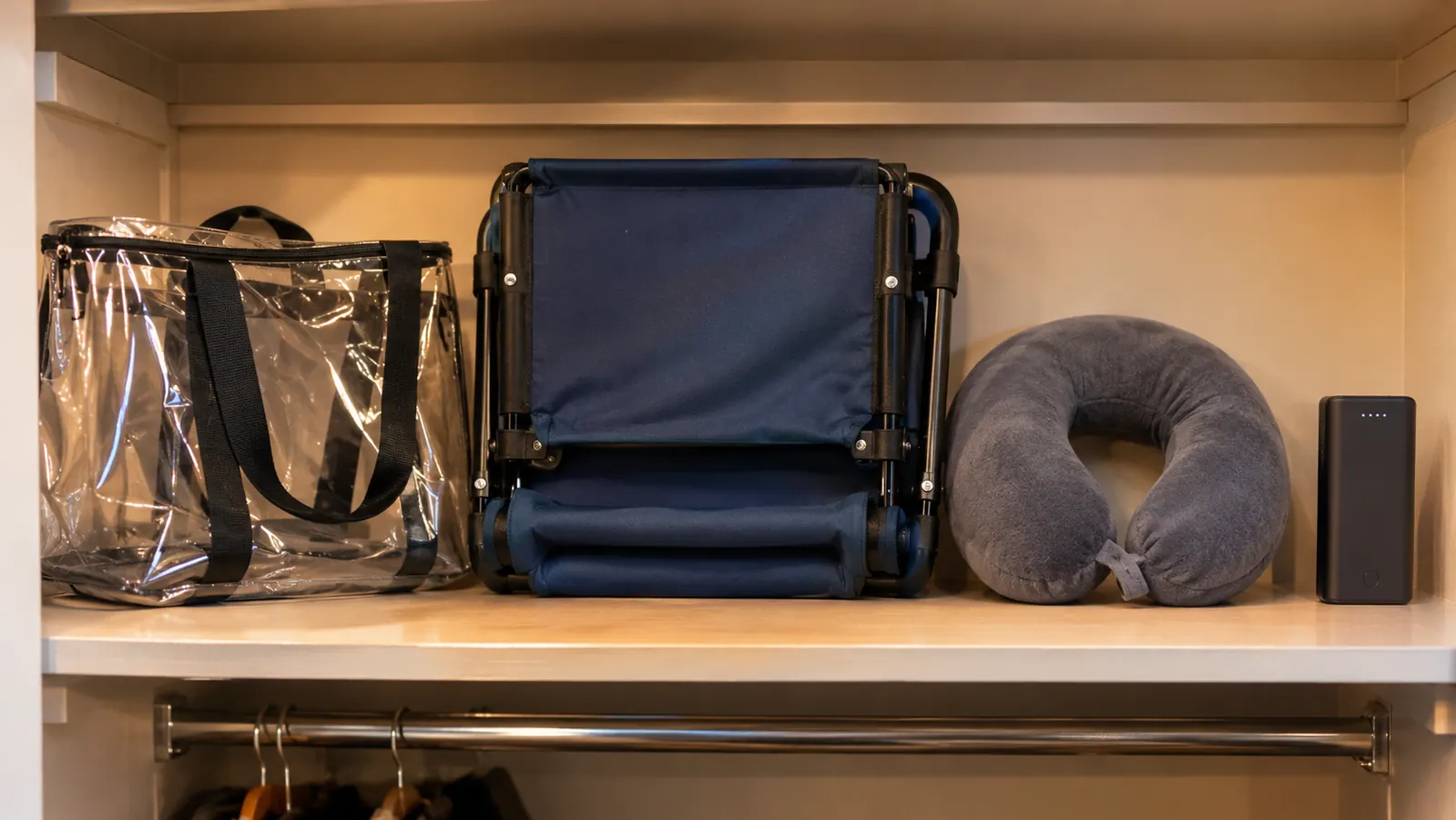
What the Numbers Mean on a Game Day
The part I underrated is the recharge. Filling the power bank from empty takes about 5.4 hours on the wall charger. That is most of an evening. So the routine is not the morning of the game. The routine is the night before, after dinner, plugged in on the kitchen counter, and I unplug it before bed. If you are somebody who remembers things in the morning, this is the one part of owning it that will get on your nerves.
It is also denser and heavier than the size suggests, and the shell is a woven nylon rather than the smooth plastic most of these come in. After fourteen months of living in a console and riding in and out of a bag, mine has no cracks and no shiny worn spots. It has picked up a scuff or two, which I do not care about on a piece of gear that lives in a truck.
If you fly, the capacity is under the airline carry-on limit and the listing notes it is built to pass airport security. That matches what I have seen on two flights a season. It still goes in the carry-on, it still never goes in a checked bag, and I still check the airline's own rules, because the rules belong to them and they change.
One more thing worth saying, and it applies to whichever one you carry. Check the stadium's own website before you leave the house. Bag rules differ from building to building and they change from season to season, and it is worth a look at what they say about power banks while you are on that page. I have never had a problem at a gate with mine, and I still look every time.
What I Liked
- 20,000 mAh takes two phones through a long game day with charge left over
- Three ports and built in cables, so there is nothing else to pack
- Digital display shows the exact percentage remaining
- 22.5W fast charging gets a phone back to useful in minutes, not halves
- Woven nylon shell has held up through fourteen months of console and bag duty
- Sits under the carry-on limit and has flown without a question
Where It Falls Short
- About 5.4 hours to recharge, so it is a night-before job
- Denser and heavier than the size suggests, it lives in the bag
- One more object to remember at the door
- Needs an outlet and an evening when you are actually home
Who Should Buy Which
Buy the power bank if you are doing what we do. Two phones, a long drive, a parking lot that fills early and a stadium that empties slow. Buy it if you have changed phones in the last couple of years and you have a drawer with a case that fits nothing you own. Buy it if you want one thing in the bag that will charge everything you carry, including the tablet that keeps a back seat quiet on the ride home.
One last bit of arithmetic, since it is the thing I get asked about. A season for us is six to eight road games. At two top offs per game day across two phones, that is a working weekend every couple of weeks, and I recharge the bank at home in between. Fourteen months in, it has not lost a noticeable step. The display reads what it read in the first month. I have no way to measure it beyond that, and I am not going to pretend I do.
Look hard at a battery case if you want nothing extra to carry and you keep a phone long enough to get real use out of the case. That is a fair trade and I would not talk you out of it. It just was not mine. I changed phones, I lost the case, and then I stood in a parking lot holding a phone that would not wake up.
Either way, do the boring thing. Charge what you carry the night before. Put the charger where you will trip over it on the way out. And read the stadium's rules before you drive, because nothing about a gate is consistent from one building to the next.
The one thing in the bag I would not drive to a game without
Fourteen months, six to eight road games a season, two flights, and it has never been the reason we were late. It rides in the console, moves to the clear bag at the parking lot, and comes home with us.
Amazon See the INIU Power Bank on Amazon →