
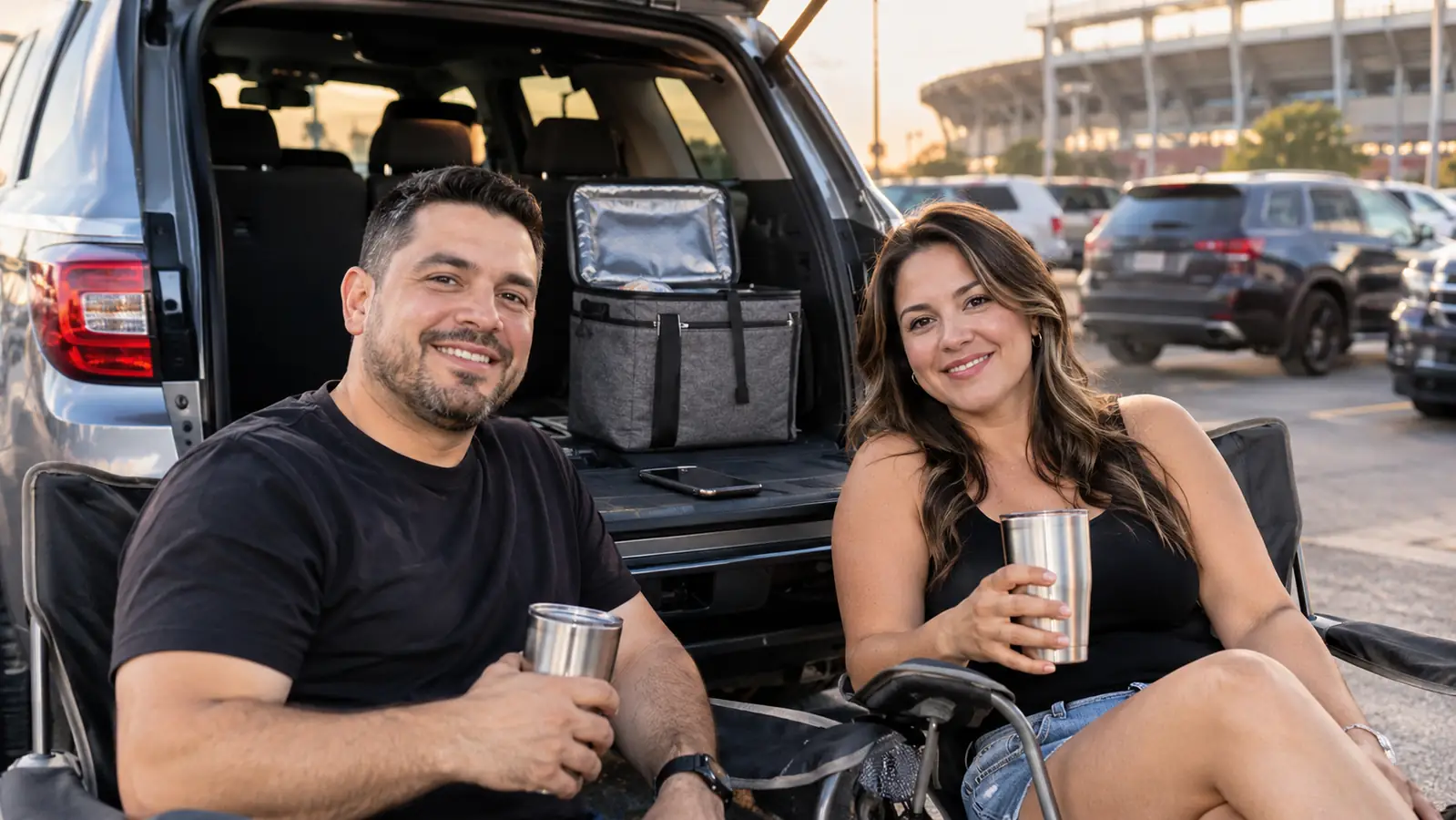
Fifteen months ago I stood in a parking lot about forty minutes before kickoff holding a phone that had just gone dark. Both of our digital tickets lived on it. Renee's phone still had a little charge left, so we moved the tickets across to hers, walked to the gate and missed nothing but the anthem. I have thought about that afternoon more than any game since, and not because of the football. I thought about the twenty minutes I spent doing arithmetic in my head over whether we were getting in at all. We drive to six to eight road games a season and fly to about two. Since that day there has been an INIU power bank in the center console of the Tahoe for every one of them.
What follows is the routine I actually use, in the order I use it. None of it is clever and none of it takes more than a few minutes a trip. The one time I skipped part of it is the afternoon above. If you take one thing from this, take the first step, because the other four do not matter if the stadium will not let the thing through the gate.
The dead-phone fix that lives in the center console
20,000 mAh, 22.5W fast charging, built-in cables, three ports and a display that reads out what is left instead of four little bars you have to guess at. It rides in the console until the lot, then it goes in the clear bag.
Amazon Check Today's Price on Amazon →Step 1: Read the Stadium's Rule Before You Pack Anything
Stadiums publish their own bag and prohibited item rules, and they do not all read the same. Many pro stadiums post a clear bag policy with a size limit, and the 12 by 6 by 12 inch clear tote Renee carries is the size many of them publish. Many, not all. I check that stadium's own website the week we leave, not the week we bought the tickets, because these rules get updated and a policy from two seasons back is not a policy anymore. Read the page that belongs to that building and that season.
The same goes for the INIU itself. Some venues publish what they allow for portable chargers and some say nothing at all, and when a page is silent I do not treat silence as permission. I read the prohibited items list, I read the bag policy, and if the two together leave me unsure I call the number on the site during the week. That call takes five minutes and it has kept me out of an argument at a gate I would rather not have.
Flying changes the answer a little. The bank goes in the carry-on and never in checked luggage, and the listing puts its capacity inside what airport screening allows for carry-on batteries. I still check our airline's own page before we fly, because the airline's rule is the one that applies to the airplane and the stadium's rule is the one that applies at the gate. Those are two different rules and they do not care about each other.
Step 2: Charge Everything the Night Before, Not the Morning Of
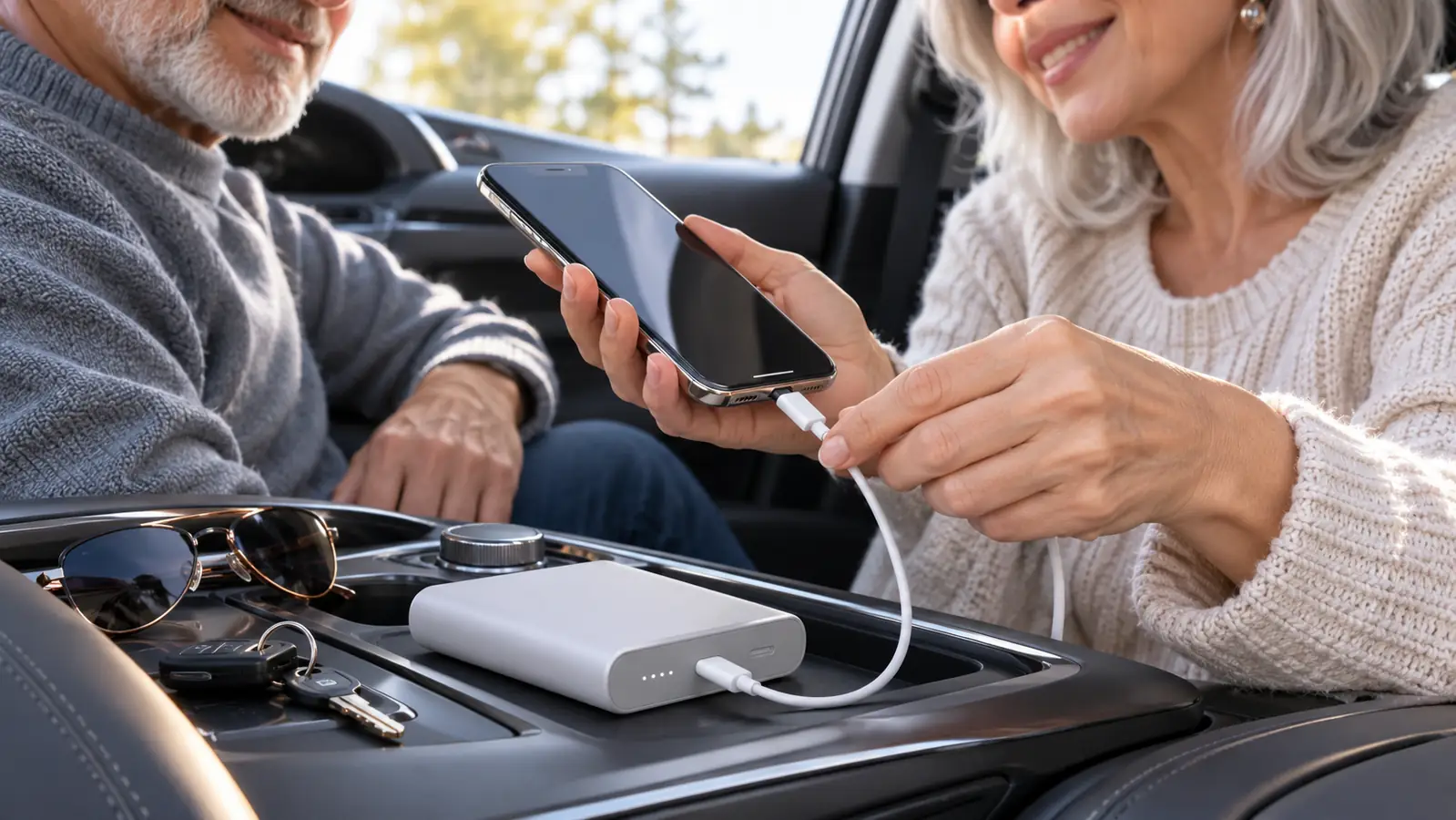
A full recharge on the INIU takes about 5.4 hours, which is most of an evening. I plug it in before dinner rather than at bedtime, so I can look at the display before I go to sleep and see a full number instead of hoping. Both phones go on their kitchen chargers at the same time. In the morning the bank is unplugged and back in the center console, and the phones are in our pockets, and that is the whole job.
The digital display is the part I did not expect to care about. It reads out a number, so I am not squinting at four little bars and arguing with myself about whether three of them mean half or a quarter. I press the button, I read what is left, and I know whether I am leaving the house with a full bank or one that needs another hour on the wall. It is a small thing and it is the reason I stopped guessing about chargers entirely.
I also top both phones off in the parking lot before we walk in. That is not the same as charging them overnight, it is a last look. If a phone is already up near full, the bank does not get used at all and it goes into the clear bag with a full display. If a phone is at forty, it gets twenty minutes on the cable while we finish our sandwiches. Either way we know where we stand before the Tahoe gets locked.
Step 3: Learn the Ports Before You Are Sitting in the Car
The INIU has three ports and built-in cables, so there is nothing to dig out of a bag and nothing to leave on the kitchen counter. That matters for us because there are two phones. One goes on a built-in cable and the other goes on a port, and both charge at the same time without an argument about whose turn it is. I worked that out in the driveway at home on a Tuesday, not in a parking lot on a Saturday.
The first week you own a bank like this, plug each phone into each option once, at home, with the phone where it actually sits in the vehicle. You want to know the cable reaches from the console to the middle of the seat and that the phone is not dangling by the cord. You also want to know which of you is going to hand a phone across the console. Five minutes in the driveway is worth more than ten minutes of fumbling with a line of traffic behind you.
The fast charging on the listing is real in the sense that it moves a modern phone quickly, and that matters most when you are in a hurry. I do not count minutes. I plug in, I glance at the display, and I unplug when the phone is comfortably up. The goal is not a hundred percent. The goal is to make sure the phone survives the walk from the truck to the seats and the four hours after that.
The phone that dies in the parking lot is not a battery problem. It is a ticket problem, and it turns a good afternoon into twenty minutes of arithmetic.
Step 4: Keep It Where Your Hand Is, Not at the Bottom of a Bag
On a road trip the bank lives in the center console of the Tahoe from the time we back out of the driveway. It is not in a door pocket, not under a seat, not in the cooler bag. It stays in the console until we park, and then it moves into the clear bag and stays there for the rest of the day. That is the one place it goes and it does not vary from trip to trip. The shell on the INIU is woven nylon rather than smooth plastic, which is the sort of detail you notice after a year of it riding next to a set of keys.
Renee usually carries the bag, so the rule between us is simple. She knows the bank is in there and she knows which pocket it is in. The clear tote is why that works, because you can see through the side of it and nobody has to unzip three compartments hunting for a charger. It goes in the front section, the zipper closes, and the strap goes over her shoulder.
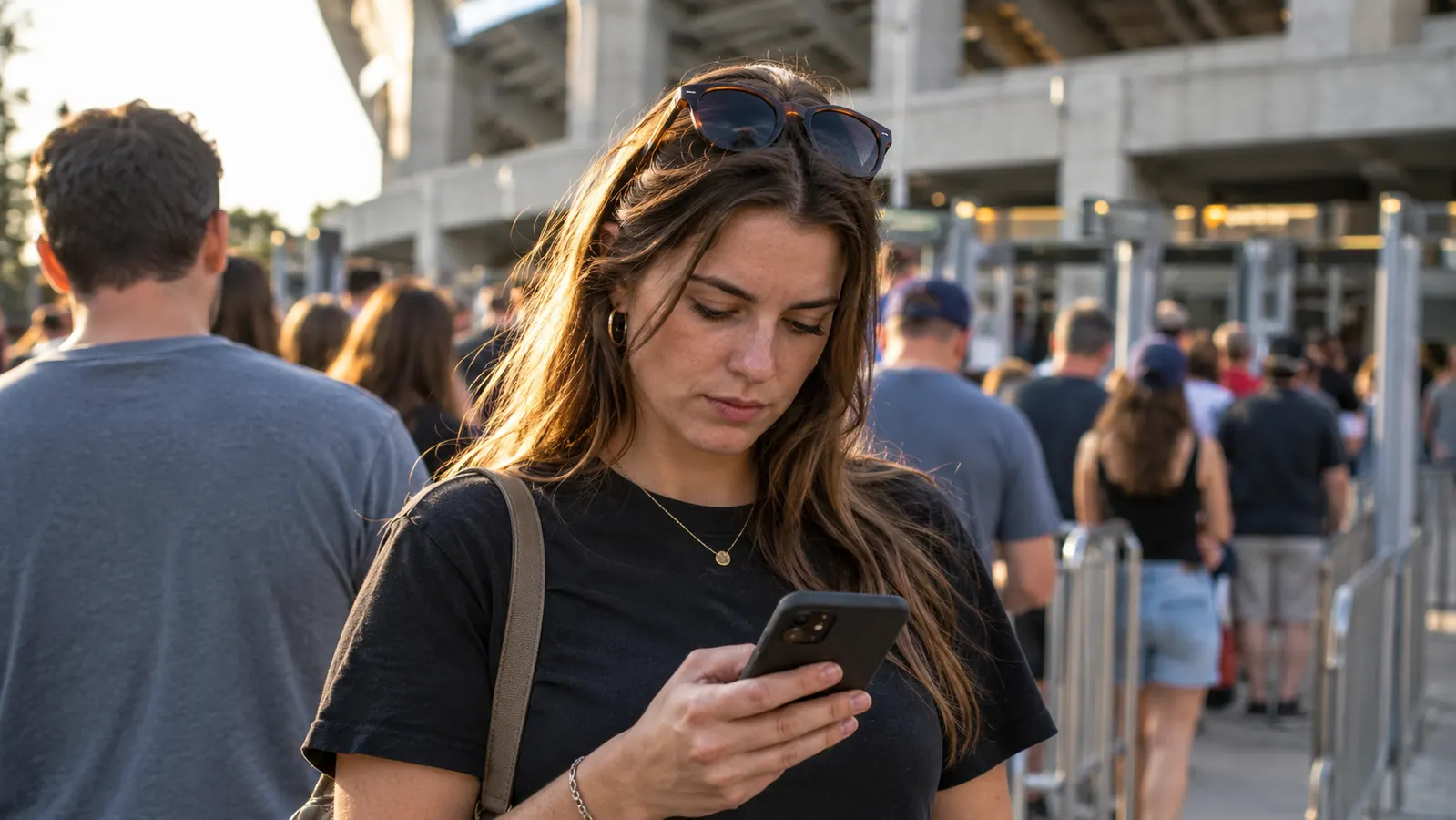
At the gate, keep it near the top. The guard is going to look inside the bag, and a power bank buried under a poncho and a wallet is a power bank that has to be dug out in front of a line of people. Near the top, zipper open, phone already in your hand with the ticket up on the screen. That is the whole sequence and it takes about ten seconds.
Step 5: Spend the Battery on Purpose
A phone works harder inside a crowded stadium than it does on your couch. It hunts for a signal in a building full of people doing the same thing, and that hunt drains a battery faster than video does. Add photos, a couple of short videos, checking the other games at halftime, and the ticket app you have to open again to find your section, and a phone that started the day full can be looking for a charger by the third quarter.
So we top off on purpose. One phone gets fifteen or twenty minutes on the bank while the other stays in a pocket, then we swap. On a long day, with a long walk in and a longer walk back, we do it twice. I have not had the INIU run flat on us across a full day, and we have never walked back to the Tahoe with the display under a quarter. That is not a guarantee for anybody else. It is what fourteen months of doing it this way has looked like for us.
The flashlight gets used more than I expected. Not inside the stadium, where there is plenty of light, but in the lot afterwards, hunting for the door handle on a silver Tahoe among a few hundred other trucks and SUVs. It is a small button and a small light, and it has ended more than one slow walk back to the car.
What Else Helps
The clear bag is the other half of this routine. Ours is the BAGAIL tote, 12 by 6 by 12 inches, and it holds the INIU, two phones, a wallet, keys, a small pack of tissues and a rain poncho without any of it turning into a puzzle. The weak spots are honest ones. Everybody in line can see what you are carrying, the plastic stiffens up on a cold day, and after two seasons it looks a little cloudy. It wipes clean with a damp cloth and it has held up at about eighteen games.
The cooler stays in the Tahoe. It never goes past the parking lot, and that is not a rule anybody at the stadium made, it is just what works for two people in their sixties who would rather not carry a bag of water and sandwiches up a ramp. We eat and drink at the back of the truck before we walk in, and on the days a stadium will not allow a seat with a back, the seats get locked in the back with the cooler.
Two smaller habits. We top off the bank the night before every trip, not just the long ones, because a two hour drive and a four hour game is still six hours of a phone working. And between trips the INIU comes inside with the rest of the gear and sits on the shelf in the hall closet next to the bag, rather than cooking in a hot vehicle for a month. Then it gets charged again before we leave. A battery that lives in a console from August to December is a battery you should not be surprised by.
One more, and it is the habit that came out of that dead phone afternoon. Before we lock the truck, Renee and I both look at our phones and confirm the tickets are on both of them. It costs ten seconds and it means neither of us is the single point of failure on the walk in.
One less thing to worry about at the gate
This is the same INIU that has ridden in the center console for fourteen months of road games. Check that stadium's rules, charge it before dinner the night before, and put it in the bag near the top. The rest of the day takes care of itself.
Amazon Check Today's Price on Amazon →